Digital Newsletter
Each week our editor Phil Alsop rounds up the most popular articles, videos and expert opinions. We compile this into a Digital Newsletter and send it straight to your inbox every week.
Digital Magazines
We'll let you know each time a new edition of Data Centre Solutions is released so that you're always kept up-to-date with the latest and greatest news and press releases.
Video Magazines
The Data Centre Solutions Video magazine contains the latest Zoom interviews with experts in the industry.
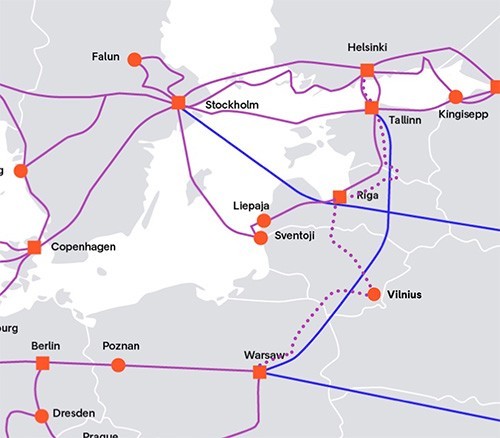
Arelion today announced the completion of a major expansion of its Baltic network, constructing a fully diverse, high-capacity route between Helsinki and Warsaw, creating a resilient ring for traffic between Sweden, Finland, Estonia, Latvia, Lithuania and Poland. The new terrestrial path reduces latency between the Baltics and Western Europe, increases diversity in a geopolitically sensitive region and secures future capacity for an underserved EU region. Arelion’s expansion delivers backbone-grade performance with predictable service-level agreements (SLAs) to reduce downtime risk, ensuring reliable business continuity for customers in cloud, financial services, manufacturing and other critical sectors.
By combining fibres from regional partners with Arelion’s own infrastructure, the expansion provides enterprises and service providers with scalable, future-ready connectivity amid increased investment in local markets. Finland’s data centre market is projected to reach $5.23 billion by 2030, growing at a CAGR of 54.6 percent, underscoring the importance of robust digital infrastructure across the Baltic region. The project, partially funded by the EU’s Connecting Europe Facility 2 (CEF2) program, highlights how strategic investment can advance digital sovereignty in a historically underserved region.
This diverse terrestrial route connects the Baltics to Western Europe via subsea and land systems from Helsinki through the Baltics to Warsaw, bypassing Copenhagen and Stockholm to avoid bottlenecks and ensure high-availability connectivity for customers. Leveraging the latest open optical line systems with 400G coherent pluggable optics and 1.6 Tb/s Waves, the route provides long-term scalability to support the massive data flows of next-generation applications in Europe’s growing AI sectors.
The investment provides customers with reliable, secure connectivity from Baltic markets into Nordic, Central and Western European data centre hubs. Organisations with latency-sensitive applications benefit from consistent, predictable performance, resilient infrastructure and backbone-level security that mitigates DDoS attacks and routing threats before they reach enterprise networks. The route also offers metro routing flexibility in major cities, including Warsaw and Helsinki, and supports scalable IP Transit, Dedicated Internet Access (DIA), Ethernet, DDoS Mitigation and other global services.
The network expansion connects numerous Points-of-Presence (PoPs) throughout the region, including:
“This new route enhances diversity and bandwidth between the Baltics and Western Europe, delivering the secure, low-latency connectivity our customers need to scale AI and cloud applications,” said Mattias Fridström, Vice President and Chief Evangelist at Arelion. “With support from the EU, we are strengthening Europe’s digital sovereignty while ensuring that enterprises and hyperscale operators can rely on resilient infrastructure to power innovation.”