Digital Newsletter
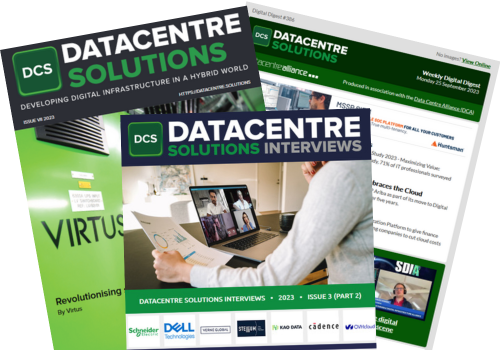
Each week our editor Phil Alsop rounds up the most popular articles, videos and expert opinions. We compile this into a Digital Newsletter and send it straight to your inbox every week.
Digital Magazines
We'll let you know each time a new edition of Data Centre Solutions is released so that you're always kept up-to-date with the latest and greatest news and press releases.
Video Magazines
The Data Centre Solutions Video magazine contains the latest Zoom interviews with experts in the industry.
Sophie Milburn: There is growing customer expectation for services to be seamless, immediate, and always available on demand, especially when it comes to chat, voice, messaging apps, and email. How does Zendesk approach this and go about keeping things quick and up to date?
Matthias Goehler: This is something that we have done even before the AI age. You can start a conversation in one channel and then continue in another. You can reach out to a company in a messaging channel, and then, if the company wants to send you a document, it might be better to send it as an email, so you can just move from one channel to the other. The agent would never lose the context or the conversation that has already happened. That’s something we’ve done forever, and that’s something we’re also doing now in the AI age, where AI agents are deployed across all the different channels.
Sophie Milburn: How does AI play a part in that, and what are you seeing as the biggest shift with AI at the moment?
Matthias Goehler: The big goal that our customers are working towards is automation. We believe we can automate up to eighty percent of all interactions, and that is also true across all the different channels. It could be messaging, it could be email, it could be voice. We have AI agents for all of these channels, and then we help our customers automate a good part of their interactions. Mainly, it’s the simple, high-volume, highly repetitive interactions and processes. This is where you would normally start and say, “Let’s build automations first,” and then you can increase the scope over time.
Sophie Milburn: What would you personally say you are most excited about with AI at Zendesk at the moment?
Matthias Goehler: I am personally very excited about our whole AI journey, not only for you or for me as consumers. The visible part is the AI agents. We are starting to interact with AI agents, but we are also using AI for the rest of the system. We call it an admin co-pilot. This is an admin where you can use AI to set up, configure, and optimise your system and use AI for analytics so that you don’t have to create all of these deep-dive analyses or rely on data scientists. You can prompt the system, and it will do analysis for you and come up with generated reports and dashboards.
Sophie Milburn: You mentioned the admin agent alongside several other AI agents being introduced across the platform. How do you ensure all those capabilities work together cohesively while maintaining a unified and integrated platform experience?
Matthias Goehler: First of all, there are different use cases, so we are thinking about different use cases and how we can apply AI to those. Another example is knowledge. When you think about knowledge and you have a knowledge base, customers have multiple thousand articles. In the past, that’s a massive task. You would have to write all of them and make sure they’re always up to date. Then perhaps you need to translate them into all languages. Today, we can use AI to identify white spaces, suggest articles, and do translation of articles in all languages.
As a human, your role in the future will more be like reading them, approving them, and potentially changing them where needed. We think about these different use cases and how we can apply AI, and we refer to them as knowledge co-pilot and analyst co-pilot.
In terms of platform, this is something that we have worked on over the last couple of years to really make it one platform. So that it all sits on the same technology foundation, and you can apply all of these use cases very consistently. Everything is also integrated with each other. We call it our learning loop. The system, in an abstract way, monitors itself and suggests improvements over time. This could be an improvement to a procedure that you have set up for automation, knowledge articles, configuration of the system, or integrations that are missing.
Sophie Milburn: Trust and security were mentioned quite a lot earlier, particularly across EMEA, where those concerns tend to be especially relevant. How does Zendesk approach security and trust as these capabilities continue to evolve?
Matthias Goehler: First of all, I think this has always been a concern of our customers because we are dealing with very sensitive data, the data of our customers’ customers, and they want to make sure that this data is safe. It has always been a big concern and focus of Zendesk to make sure that we have a safe and trusted environment. We are doing the same now in the AI world, where AI has some new challenges that you need to address, like how to make sure that there is no customer data that is being used to train or optimise our system.
Sophie Milburn: With everything becoming increasingly complex as we move forward, what predictions do you have for the years ahead?
Matthias Goehler: I am really excited about the automation journey, and I think we are still in the middle of it. There are no customers that I am currently talking to that have not started or are in the middle of their AI journey. There are still a lot of customers who are just in the middle of it, so there is still much more potential to achieve with our customers. I am also excited about what this could also mean in terms of how customer service evolves, which could become much more proactive than reactive.
Another point is that if you take a lot of these high-volume repetitive tasks away from human agents, you free up time. Companies that do this well start to think about how they can use this freed-up time so that human agents can handle more complex use cases. For example, difficult customer situations where customers might be angry, you need a lot of real human empathy to talk with them.
Last but not least, in customer service, we have always been focused on things like resolution time. In customer service, you have this wealth of data and this wealth of information, but it is all very unstructured. If you can use AI to actually start looking into all of your tickets and say, “What are the problems? Why are customers reaching out?” and create some sort of feedback loop back to product and back to operations, and fix some of these underlying issues more systematically, you will increase customer satisfaction over time.