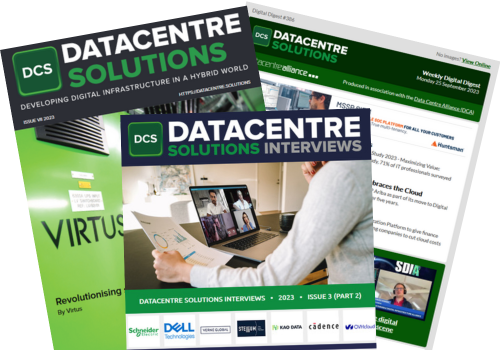
Digital Newsletter
Each week our editor Phil Alsop rounds up the most popular articles, videos and expert opinions. We compile this into a Digital Newsletter and send it straight to your inbox every week.
Digital Magazines
We'll let you know each time a new edition of Data Centre Solutions is released so that you're always kept up-to-date with the latest and greatest news and press releases.
Video Magazines
The Data Centre Solutions Video magazine contains the latest Zoom interviews with experts in the industry.
Driving enterprise expansion at Atlassian
Duffy joined Atlassian in early 2025 after close to two decades at SAP, where he held a range of senior leadership roles across sales, regional operations, and transformation programmes, including running the EMEA North business and leading the rollout of RISE with SAP. His background spans large-scale enterprise change, go-to-market strategy, and partner-led growth across global markets.
He joined Atlassian, a company known for its long-standing product-led growth model and a customer base of more than 350,000 organisations. Built on a self-serve foundation, Atlassian has scaled widely through adoption-led expansion, with products that have traditionally grown from the bottom up within organisations.
His remit now includes supporting the next stage of that model by developing a more structured enterprise sales capability alongside Atlassian’s existing product-led approach. This reflects a broader effort to align customer success, revenue, and go-to-market functions as the company continues to scale across both self-serve and enterprise segments.
The shift from product-led scale to enterprise expansion
Atlassian’s model has historically been defined by acquisition at scale, with products that enter organisations organically and expand as teams embed them into everyday workflows. Over time, that adoption has created a large and embedded customer base where usage often grows long after the initial entry point.
The next phase is about what gets built on top of that foundation.
Alongside continued product-led expansion, Atlassian is now layering in a more structured enterprise sales motion. The aim is not to replace what has worked but to extend it, supporting customers as their usage matures and as they look to unlock additional value through broader deployment, cloud migration and more integrated ways of working. As Duffy highlights, the next phase is now about adding “an enterprise sales motion to help those companies grow even further.”
That shift also reflects a broader transformation taking place inside the organisation itself. As customers move further into the cloud, they are rethinking how processes are designed and how work is delivered, creating new opportunities for deeper engagement. At the same time, the ecosystem around Atlassian is playing an increasingly important role in enabling that transition, connecting product adoption with implementation at scale.
For revenue leadership more broadly, the focus is moving away from pure acquisition towards orchestration. As Duffy explains, the focus is on customer-centric selling, where the emphasis is on delivering tangible business outcomes for customers while also ensuring the partner ecosystem is structured and positioned for success.
Identifying readiness to scale
Atlassian has developed a structured view of how customers move through their journey, particularly when shifting from self-serve adoption into deeper engagement with account teams. Rather than relying on intuition alone, the company looks at behavioural and commercial signals that indicate when a customer is ready to transition into a more supported motion.
As Duffy notes, “we have a system in place to look at and see where a customer is in their journey, and when we think a customer is ready to graduate,” referring to the point at which customers move into account-led engagement. This “graduation” is based on observable behaviour, particularly buying trends that signal growing adoption and increased reliance on the platform.
Importantly, this transition is not treated as a one-way commercial step, but as a mutual inflection point. He states that “the data shows us that when they are served by an account team that is a win-win for Atlassian and a win-win for the customer,” underlining the idea that timing and readiness directly influence outcomes on both sides.
Underlying this approach is a strong emphasis on alignment with customer intent. The starting point is not product or sales motion, but what the customer is trying to achieve as a business. Whether the objective is efficiency, cost reduction or broader transformation, the focus is on ensuring engagement is anchored in outcomes rather than transactions.
Where partners amplify customer impact
Atlassian’s partner ecosystem plays a central role in how the company scales both reach and impact. With around 700 partners globally, the network is deeply embedded in the business, engaging in a significant majority of customer activity and acting as a key extension of the organisation’s commercial and delivery capability.
Rather than operating at the edges, partners are closely involved in how value is created and expanded within customer accounts. Their relationships with customers provide an additional layer of insight and access, enabling deeper conversations and more effective execution across complex environments. Duffy emphasises that, “they have relationships with our customers, which is incredibly important. We need to lean in and leverage those relationships as well.” This becomes particularly critical as customers increase their usage and move into more sophisticated deployment models.
The value of this model becomes most visible in the depth of engagement it enables. Working closely with partners allows for more meaningful discussions around outcomes, which in turn supports larger and more effective deployments. This creates a dynamic where both Atlassian and its partners are able to grow alongside the customer, rather than in parallel to them.
Increasingly, the focus is shifting towards outcomes rather than transactions. For partners, this means a stronger emphasis on services-led growth and long-term value creation, supported by continued investment in partner enablement and sales support. The direction of travel is towards a model where success is measured less by individual transactions and more by the sustained value delivered across the customer lifecycle.
Standardising at scale while keeping workflows intact
Supporting large customers through standardisation and scale is less about technical migration alone and more about managing change in a way that preserves continuity. In practice, many organisations begin from a product-led foundation, often using tools like Jira and Confluence, before evolving from on-premise or data centre environments towards the cloud.
The process typically starts with a shared understanding between customer, vendor, and partner. This includes establishing a clear roadmap for migration, defining timelines, and building a business case for change. The focus is not only on how to move, but on why the move is taking place and what value it is expected to unlock.
The most important distinction is between simple migration and true transformation. According to Duffy, “if we just take the customer and move them into the cloud, this is a lift and shift, and nothing changes.” A lift and shift approach moves systems without fundamentally changing how work is done. A transformation-led approach, by contrast, uses the move to the cloud as an opportunity to reimagine workflows, processes, and productivity. This includes rethinking how tasks are assigned, how teams operate, and how value is created across the organisation.
The aim is to take customers on a journey from existing systems to a future state that is materially different, not just technically updated. That requires a clear narrative around what is changing and why, alongside a practical framework for how that change is implemented.
Not all customers move at the same pace. Some adopt transformation quickly, while others require more time to work through legacy constraints and operational complexity. In these cases, the role of partners becomes even more important in helping bridge understanding, build confidence, and support adoption.
Ultimately, the objective is not just migration to the cloud, but to enable a fundamentally different way of working once there.
Turning AI adoption into measurable business impact
AI is reshaping buyer behaviour across the technology landscape, but not in a uniform or straightforward way. For platforms like Jira and Confluence, it has rapidly moved from an emerging consideration to a top priority for customers, while simultaneously introducing a new layer of uncertainty around where to begin and how to measure success.
On one hand, organisations are under pressure to adopt AI quickly. On the other, many are still working through how to turn that adoption into something tangible and defensible internally. Duffy explains that it has moved from the top of the priority list for them, but that there is also significant concern as they are unsure where to go or what to do, while still needing to demonstrate associated value. The emphasis is no longer just on experimentation, but on demonstrating clear value back to the business.
That shift is changing the nature of conversations with customers. Productivity improvements alone are no longer enough. Time savings and efficiency gains are increasingly seen as secondary unless they can be translated into financial outcomes. The expectation now is that AI investments must connect directly to measurable returns, often expressed in cost reduction or quantifiable business impact.
This creates a consistent theme across industries and customer types. Whether in early discussions or more advanced engagements, the underlying question remains the same: what is the return? As a result, vendors are being pushed to frame AI not just in terms of capability, but in terms of concrete business value.
At the same time, the pace of change is accelerating the entire cycle. Unlike previous waves of transformation, where adoption curves were more gradual, AI is compressing timelines and forcing faster iteration. What felt current months ago can quickly become outdated, creating a constant need to reassess and adapt.
While this introduces complexity, it is also reshaping expectations around agility. Organisations are being forced to evolve in real time, and the ability to pivot quickly is becoming as important as the technology itself.
Building the next phase of Atlassian’s platform evolution
Looking ahead, the next phase for Atlassian is defined by consolidation, expansion, and continued evolution of its platform strategy at scale. A key milestone sits in the migration of remaining customers to the cloud, particularly following the end of life of its data centre offering. As Duffy notes, “we will have migrated all of our customers to the cloud. Now that we’ve announced the end of life of data centre, that’s going to be critically important.” This transition is positioned not just as a technical shift, but as a broader change in how customers experience and engage with the platform.
Alongside this, a major focus is on increasing adoption of AI capabilities across the entire customer base. Rather than introducing friction through layered adoption models, Atlassian has taken a more open approach, making these capabilities available broadly in order to accelerate familiarity, usage, and value creation. The expectation is that this will become a defining driver of customer experience over time. “We’re in a very different situation than other players that are out there because we’ve given our customers access to Rovo,” Duffy explains.
This strategy reflects a deliberate balance between pace and patience. While some organisations have moved aggressively in pushing new AI products into the market, Atlassian’s approach has been more incremental, building on its existing product-led foundation where adoption typically scales organically through usage. The goal is to allow change to flow through real customer engagement rather than forced transition.
Recent acquisitions are also expected to play a growing role in shaping the future portfolio. DX and The Browser Company are being positioned as complementary components within a broader ecosystem, with the potential to influence how work is experienced and delivered across the suite. These additions point towards a more integrated product landscape over time.
Taken together, the direction of travel is towards a more unified platform where cloud, AI, and ecosystem capabilities converge. The emphasis is less on individual products and more on how they work together across the ecosystem.