Digital Newsletter
Each week our editor Phil Alsop rounds up the most popular articles, videos and expert opinions. We compile this into a Digital Newsletter and send it straight to your inbox every week.
Digital Magazines
We'll let you know each time a new edition of Data Centre Solutions is released so that you're always kept up-to-date with the latest and greatest news and press releases.
Video Magazines
The Data Centre Solutions Video magazine contains the latest Zoom interviews with experts in the industry.
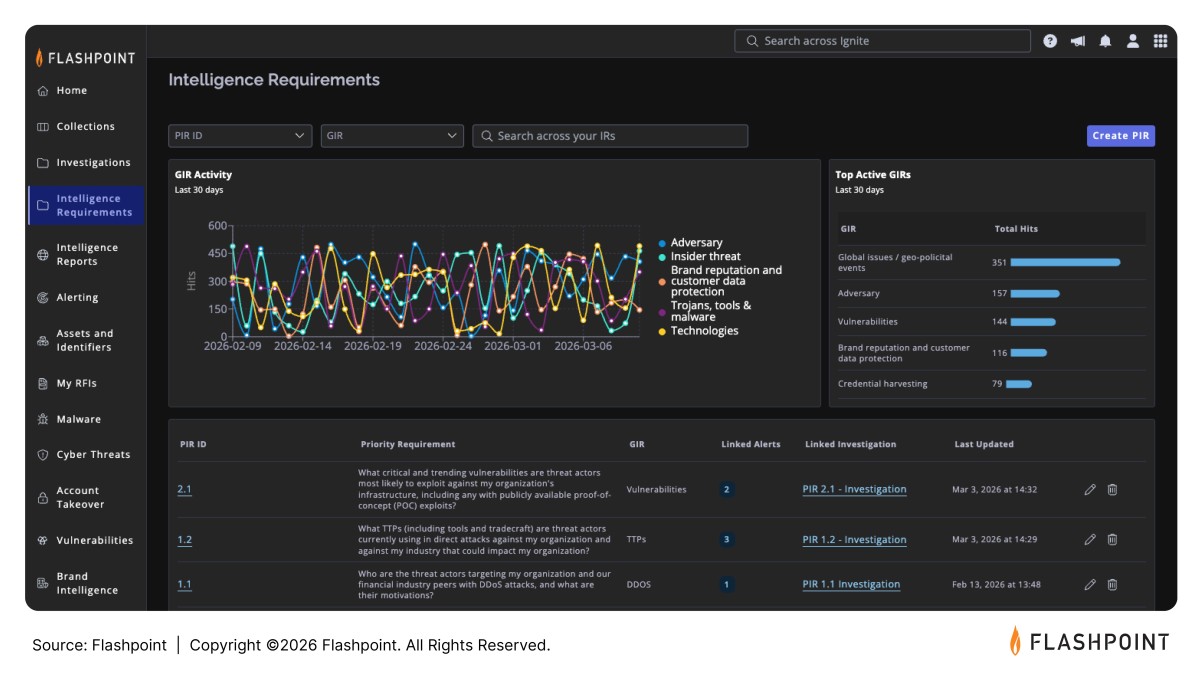
Flashpoint has introduced an Intelligence Requirements (IRs) workflow within its Ignite platform. The feature is designed to support organisations in defining, managing, and operationalising General Intelligence Requirements (GIRs) and Priority Intelligence Requirements (PIRs).
The development of Intelligence Requirements is intended to address a common challenge in cyber threat intelligence (CTI): aligning intelligence activities with organisational priorities. While CTI is widely used, connecting intelligence outputs to business or executive decision-making processes can be complex. The framework provides a structured way to organise intelligence work within a centralised system.
Within the Flashpoint Ignite platform, the IRs workflow links monitoring activities, investigative tasks, and reporting functions. This structure is intended to support the organisation of intelligence programmes used in decision-making and risk management.
Key aspects of the approach include:
The process typically begins with defining intelligence questions, which are then mapped to monitoring and investigative workflows. As PIRs are established, alert rules can be associated with them so that incoming signals are organised according to defined priorities.
This approach also supports the alignment of alert rules and automated or AI-assisted recommendations within the platform, aiming to reduce disconnected monitoring activity.
Throughout the workflow, intelligence activities are structured so that there is continuity between defined priorities, incoming data, investigations, and outcomes. This is intended to help teams track which areas are receiving attention and how they relate to broader organisational goals.
Overall, the IRs capability in Flashpoint Ignite is positioned as a structured method for organising cyber threat intelligence activities in relation to organisational priorities and risk management needs.