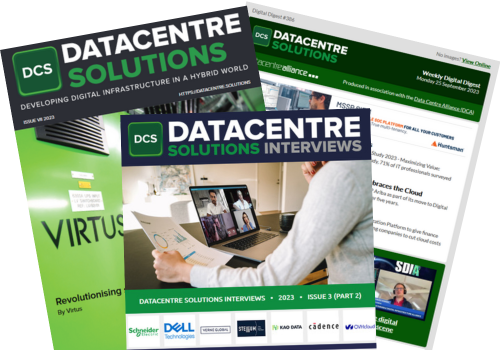
Digital Newsletter
Each week our editor Phil Alsop rounds up the most popular articles, videos and expert opinions. We compile this into a Digital Newsletter and send it straight to your inbox every week.
Digital Magazines
We'll let you know each time a new edition of Data Centre Solutions is released so that you're always kept up-to-date with the latest and greatest news and press releases.
Video Magazines
The Data Centre Solutions Video magazine contains the latest Zoom interviews with experts in the industry.
A study by Forrester Consulting (commissioned by SAP and Syniti) finds that organisations that prioritise data early - ensuring it is accurate, governed and usable at scale - are significantly more likely to realise value from transformation programmes.
Based on a composite global organisation (10,000 employees, $5B revenue), The Total Economic Impact™ Of SAP Advanced Data Migration And Management By Syniti study reports:
218% ROI and $2.8M net present value over three years
$4.1M in total benefits vs. $1.3M in costs
Efficiency gains driven by business-ready data
$2.1M saved through improved data quality and streamlined processes
$1.6M reduction in resource requirements
30% increase in operational efficiency
80% reduction in audit preparation time
Persistent data issues continue to slow transformation
Before adopting a more unified approach, organisations reported:
Fragmented tools and manual, error-prone processes
Poor data quality and limited accessibility
Inconsistent data governance and ownership across systems
Heavy reliance on external vendors
Delays, rework and rising transformation costs
In many cases, data was not in a business-ready state, limiting its ability to support decision-making or large-scale change.
From fragmented data to a stronger foundation
Organisations that addressed these challenges reported:
Stronger data governance and consistency
Faster, more confident decision-making
Reduced operational risk and lower costs
Greater agility to support ongoing transformation
By improving how data is managed across its lifecycle, organisations were better able to ensure it is complete, consistent and usable as an ongoing business asset.
Raising expectations of enterprise data
The findings point to a broader shift in how organisations need to view data. Rather than treating it as a downstream activity in transformation programmes, it must be business-ready from the outset: accurate, governed and accessible. This helps transformation run more smoothly, reduces cost and risk during delivery, and ensures organisations can continue to realise value afterwards through better decision-making, improved performance and more efficient operations.