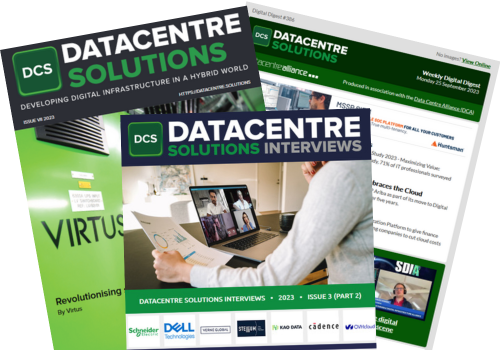
Digital Newsletter
Each week our editor Phil Alsop rounds up the most popular articles, videos and expert opinions. We compile this into a Digital Newsletter and send it straight to your inbox every week.
Digital Magazines
We'll let you know each time a new edition of Data Centre Solutions is released so that you're always kept up-to-date with the latest and greatest news and press releases.
Video Magazines
The Data Centre Solutions Video magazine contains the latest Zoom interviews with experts in the industry.
End-user computing is the integrated management and the secure delivery of application services to any user endpoint, whether that’s a smart phone, tablet, laptop, desktop - and in the future, even machines.
According to Nadeem Ahmad, Dimension Data’s Global Technology Director, “Gone are the days when end-user computing was about managing a laptop or desktop. In today’s fast-paced workplace where employees are using two, three and even four computing devices with different capabilities, models, shapes, sizes, operating systems, and security models, organisations are coming under pressure to change their approach to end-user computing.
“While the emergence of end-user computing in organisations is in the early stages of adoption, we’re seeing a shift in the enterprise from desktop computing to users demanding access to applications and data from any location and on any device. This is how enterprise employees want to work, and its set to fundamentally change the way employees work.
“Now, the focus is on what the user wants to achieve in terms of the business outcomes, new operating models such as self-service and automation, and new work styles such as activity-based working or smart working. I believe end-user computing has ushered in a real opportunity for organisations to identify business problems and apply technology solutions to solve them. However, decision-makers don’t have the time to sift through a changing vendor landscape and on the elements of end-user computing to adopt, or how to enable speed of adoption.”
“Our experts have invested hundreds of hours developing this tool to help organisations understand their current end-user computing maturity (their ‘as-is’ state) as well as their future need (their ‘to-be’ state), and identify the gap between the two, which ultimately determines their solution roadmap. In fact, the true value of end-user computing lies in applying it in an innovative way to achieve specific personal and business outcomes,” he concludes.