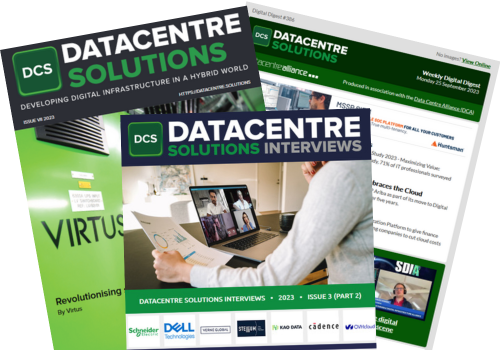
Digital Newsletter
Each week our editor Phil Alsop rounds up the most popular articles, videos and expert opinions. We compile this into a Digital Newsletter and send it straight to your inbox every week.
Digital Magazines
We'll let you know each time a new edition of Data Centre Solutions is released so that you're always kept up-to-date with the latest and greatest news and press releases.
Video Magazines
The Data Centre Solutions Video magazine contains the latest Zoom interviews with experts in the industry.
Founded in 1991, BDR Group has grown from a regional telecoms and IT solutions provider into a multifaceted technology services organisation serving thousands of businesses across the UK and Europe, with a focus on connectivity, managed services and unified communications.
Over time, the organisation has evolved alongside the channel, adapting to shifts in customer demand and the broader IT landscape. In an industry where tenure and legacy often define leadership narratives, Rahimi represents a newer generation of executive leadership emerging within the sector. Examining his journey and approach provides context not only for BDR Group’s direction but also for how younger entrepreneurs are influencing the future of the channel.
Rahimi’s entrepreneurial journey did not begin with a business plan or a clear ambition to lead a company. He left school at 14 and joined BDR Group in hands-on roles, starting with cabling and technical work. He describes those early years as formative, supported by mentors including Julian and Barman, with Julian playing a particularly significant role before his passing. He was guided by an environment that allowed him to learn through experience and grow through responsibility.
Barriers and scepticism
As a young leader stepping into a business founded by family, Rahimi acknowledges that perception was one of the first barriers he had to overcome. Age and lineage often carried assumptions, and he recognises that scepticism around being the owner’s son created an added layer of scrutiny. His response was not argument, but performance. He focused on results and built credibility through measurable achievement. He says, “One thing you can’t do is invent orders and invent money.” Breaking sales records and delivering tangible commercial success became the clearest way to shift perception and earn influence across the organisation.
That credibility was reinforced by experience across multiple parts of the business. Having worked in customer care, engineering, technical support, new business, sales and account management over many years, he built respect internally by understanding the realities of each team’s challenges. He acknowledges that tangible commercial performance was what ultimately earned respect internally and gave him a stronger voice across the business. Over time, scepticism gave way to trust.
Balancing growth and culture
As BDR Group has grown, Rahimi says the biggest shift has not been internal identity, but external scale. The company has moved from serving small local accounts to working with national and international organisations, including businesses with close to one hundred sites. That expansion has required changes in presentation, accreditation and operational capability in order to compete for larger contracts and operate “in bigger rings,” as he describes it. Growth has meant raising standards and formalising processes while maintaining agility.
BDR Group’s growth, Rahimi explains, is rooted in its origins as a traditional telco business. For the first 15 to 18 years, the company focused on telephone systems before recognising a wider opportunity in IT services. As the telecoms and mobile markets became more transactional, leadership saw a shift in customer demand and realised that there was a big opportunity to deliver IT since it had a better lifetime value in the market.
That insight drove a deliberate pivot in the business model. The product portfolio evolved toward services with greater longevity and recurring value, built into the long-term trusted relationships already established with customers. Rather than starting from scratch in new markets, BDR expanded from its existing base, deepening engagements and turning transactional connections into ongoing partnerships. That transition has been a significant contributor to sustained growth.
Despite the scale shift, he is clear that culture has remained consistent. “The culture was never an issue… It’s never been an issue to protect a culture that comes naturally to us as a family business.” He adds, “We want to ensure everybody has fun, enjoys their job, and we have a performance culture across the board.” As a family founded business, he emphasises the importance of preserving authenticity while embedding accountability and results into everyday operations. He reflects on the transition from a single office of around twenty people to multiple offices and international reach as a significant challenge. Yet he believes the company has managed to protect its core identity while adapting to new levels of demand and expectation.
Innovation and operational discipline
Speaking candidly, Rahimi acknowledges that balancing innovation with operational discipline has been challenging as the business has scaled. Much of that effort has centred on strengthening capabilities “under the bonnet,” improving software maturity and ensuring new systems deliver meaningful improvements to customer support. Rather than adopting technology for its own sake, decisions are guided by a clear objective to enhance the end user experience. He explains that when the goal is defined around better service, selecting the right platforms becomes more straightforward and outputs remain tightly aligned to customer impact. As a result, innovation is pursued with purpose, supporting growth while maintaining operational control.
Ecosystem and partnerships
When it comes to the wider MSP ecosystem, Rahimi believes relationships are just as important as strategy. He points to the company ethos of “tirelessly pursuing excellence” and says that commitment applies not only to customers, but also to staff and suppliers. In his view, those three groups form the core of a healthy and sustainable business.
He is particularly passionate about the role of suppliers and vendor partners. Rather than treating them as transactional relationships, he advocates working closely together on solution design, support models and commercial structure. That collaboration can influence everything from architecture to margins to service quality. For young MSP founders, his advice is to build strong ecosystems around your business. Treat suppliers as strategic partners, not just vendors, and put effort into relationships that support growth. When those foundations are solid, customer relationships become easier to sustain on top of them.
Talent, retention and building the right team
Talent recruitment in today’s market, Rahimi says, is challenging. He recognises that there is a broader skills shortage across the UK tech sector, making it difficult to consistently find the right people. BDR Group has addressed some of those pressures through strategic outsourcing and by expanding into international offices to widen access to talent.
Retention, however, is where he believes the business has created real advantage. He notes that the company has one of the lowest churn rates in the sector, something he attributes to deliberately investing in culture and employee experience. That includes company-wide initiatives such as annual trips, team events and personal time off for milestones like birthdays, graduations and children’s first days at school. These gestures reinforce what he describes as a family team ethos and help people feel connected to the organisation beyond their day-to-day roles.
Development is treated with equal seriousness. Training, structured progression and quarterly performance and development reviews are embedded into the business. He emphasises the importance of clarity around career growth, saying it is about “giving people complete transparency into the direction of their career so they never feel aimless.” In his view, that transparency combined with ongoing support ensures employees understand their trajectory and remain engaged over the long term.
Decision fatigue, lessons learned and unconventional advice
Running a growing business means making constant decisions, often at speed and with incomplete information. He estimates he makes more than 100 decisions a week, and by the end of it, decision fatigue sets in, leading him to joke that people should “ask him on a Monday.”
He is equally candid about the lessons learned through experience, particularly around mergers and acquisitions. Some transactions have delivered growth, while others have provided harder lessons. He describes certain post-transaction periods as defining moments that reshaped how he approaches integration, culture protection and operational alignment, guided by the principle that “protect the culture and that will protect the revenue.” Those experiences, including the scars that come with ambitious expansion, have influenced how he evaluates risk and opportunity today. Rather than viewing missteps as setbacks, he sees them as part of building maturity as a leader.
Rahimi reflects that those lessons have directly shaped the advice he now gives to younger entrepreneurs and leaders navigating growth. Experience has reinforced the value of calculated risk, cultural alignment and confidence in stepping into new areas without fear of disruption.
“Don’t be scared to take a risk or take on board something that makes you feel uncomfortable,” he says. If the business foundation, culture and people are strong, he believes performance will follow. Over time, organisations can quickly build expertise in new sectors or technologies, particularly as technology expands the capacity to scale. His broader message is to maintain that entrepreneurial mindset and remain open to expansion, experimentation and evolution.
The future of the channel
In a fast-moving technology landscape, Rahimi believes agility is essential. As he puts it, “blink fast and you’ll miss it,” highlighting how quickly trends and customer expectations evolve. For BDR Group, that means staying close to emerging technologies and ensuring adoption aligns with customers’ digital transformation journeys.
Key focus areas include cyber security, NOC and SOC capabilities and AI. These areas sit at the centre of how the business supports clients today, whether that is strengthening threat monitoring or helping organisations prepare for AI adoption. Looking ahead, the priority is to deepen these capabilities, build strong case references and embed them across customer relationships. The goal is to position BDR as the trusted partner for organisations navigating rapid technological change.