
Digital Newsletter
Each week our editor Phil Alsop rounds up the most popular articles, videos and expert opinions. We compile this into a Digital Newsletter and send it straight to your inbox every week.
Digital Magazines
We'll let you know each time a new edition of Data Centre Solutions is released so that you're always kept up-to-date with the latest and greatest news and press releases.
Video Magazines
The Data Centre Solutions Video magazine contains the latest Zoom interviews with experts in the industry.
Every QA team testing APIs eventually faces the same question: should we automate this, or test it manually? The honest answer is that it depends on what you are testing and why. AI API testing has changed what automation can do, but manual testing has not gone away. Understanding when each approach delivers value is what separates a testing strategy that works from one that wastes time. aqua cloud helps teams manage both in a single workflow, keeping results traceable regardless of which approach a tester uses.
What Is Manual API Testing?
Manual API testing is when a QA engineer sends requests to an API by hand, inspects the responses, and validates behaviour without a script doing the work. Tools like Postman make this straightforward: you construct a request, send it, and check what comes back. The tester is making judgement calls throughout, deciding what to test next based on what they observe.
This approach is particularly valuable early in development, when endpoints are changing frequently and writing automation around moving targets wastes more time than it saves. It is also where exploratory testing lives. A tester poking around an API without a fixed script often finds the edge cases that nobody thought to write a test for.
Manual testing does have limits. It does not scale. A tester can run through a handful of scenarios in a session. Running hundreds of scenarios across multiple environments, consistently, every time code changes, is not something a human can sustain without automation.
What Is Automated API Testing?
Automated API testing uses scripts or frameworks to send requests, validate responses, and report results without human input. Once the tests are written, they run as often as needed. Every commit, every deployment, every night at 2 AM if the pipeline is configured that way.
The value is consistency and scale. Automated API tests run the same checks the same way every time. They catch regressions immediately, before a broken endpoint makes it past the pipeline. For teams shipping frequently, this is not a nice-to-have. It is what makes continuous delivery possible without degrading quality.
The trade-off is the upfront investment. Writing good automated API tests takes time, and maintaining them as the API evolves takes more. Tests that break every time a response schema changes are not saving effort. They are creating it.
How Do the Two Approaches Compare?
The choice between an automated and manual API testing approach is not really a choice at all for most teams. It is a question of which to use when.
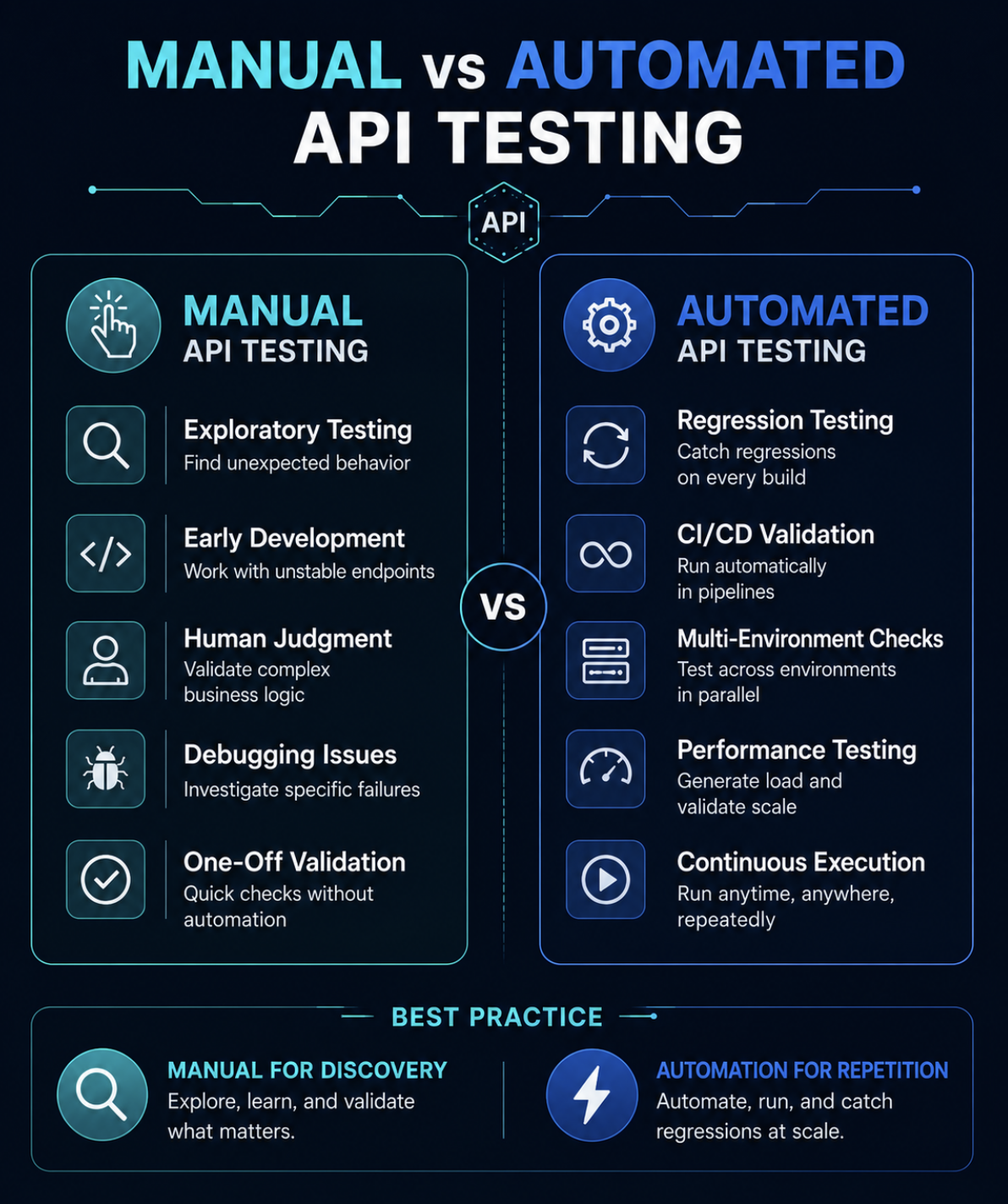
Manual API testing is better for:
Automated API testing is better for:
Most QA teams land on a combination: manual testing for exploration and early-stage work, automation for the regression suite and anything that needs to run continuously.
What Tools Do Teams Use for Each Approach?
For manual API testing, Postman is the most widely used tool. It lets testers construct requests, inspect responses, manage environments, and even run basic collections manually. Insomnia is a popular alternative. Both give a QA engineer everything needed to explore an API without writing code.
For automated API testing, the options depend on the team's technical setup. REST Assured is common for Java teams. PyTest with the requests library works well for Python. Karate DSL is designed specifically for API testing and does not require a traditional programming background. All of these integrate with CI/CD pipelines so tests run automatically on each deployment.
aqua cloud sits across both approaches. Manual test cases and automated results connect in the same platform, so a tester managing both can see coverage, track defects, and report results without switching between tools.
How Should a Team Decide Which Approach to Use?
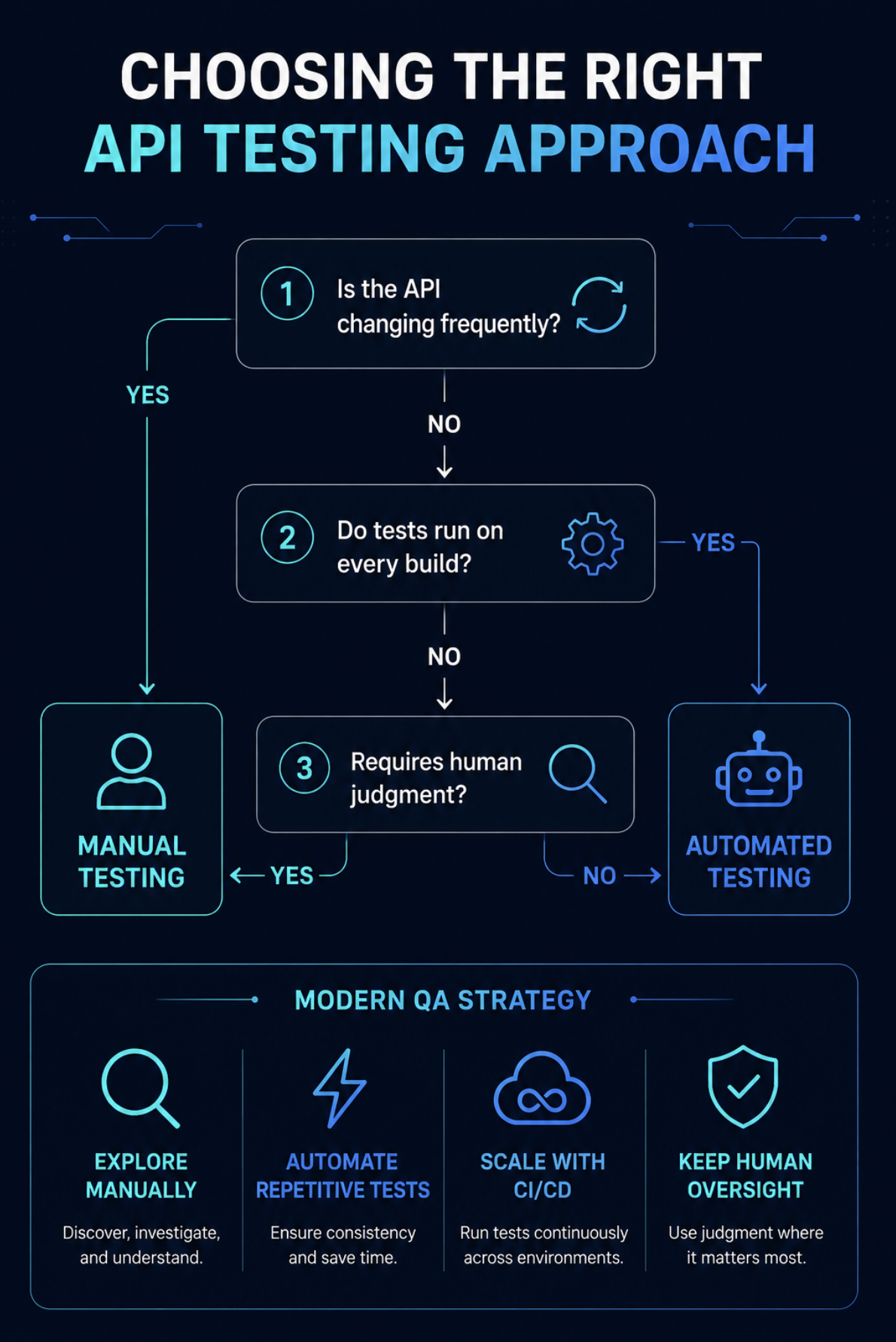
The API testing approach that makes sense for a team depends on a few practical factors.
Start by asking how stable the API is. If endpoints are being redesigned every sprint, automation written this week will be broken next week. Manual testing is more efficient during that phase.
Then ask how often the tests need to run. If the answer is once before a release, manual is fine. If the answer is on every commit, automation is the only way to make that sustainable.
Finally, ask what the tests are for. Checking that a known regression has not returned is a job for automation. Figuring out why an endpoint is returning unexpected data in a specific scenario is a job for a human.
The teams that get the most from API testing are the ones that do not treat this as a permanent decision. They automate what makes sense to automate, keep manual testing for what requires judgement, and revisit the balance as the product and the team mature.
Conclusion
Manual API testing and automated API testing are not competing approaches. They serve different purposes at different stages of development. Manual testing is where exploration and early validation happen. Automated API tests are what keep regression coverage intact as the product moves fast. A QA team that understands when to use each, and has the tooling to manage both, is in a stronger position than one that treats this as an either-or decision. Start with the scenarios that matter most, automate the ones that need to run repeatedly, and keep human judgement in the loop for everything that requires it.